
How Home Battery Storage Helps Maximise Your Solar Roof Investment and Self-Consumption
Adding a home battery to your solar panel system can significantly increase the value you get from your rooftop configuration. If you’re generating significant solar energy, a battery will help you manage your energy use rather than exporting it back to the grid.
In this article, we’ll explore how a well-sized battery, like EcoFlow PowerOcean, can boost your solar utilization, help with time-of-use tariffs, and provide reliable backup power for your household's resilience and peace of mind.
How your solar roof can reach a higher value with storage
Most homes with in roof solar PV panels generate the most energy at midday. Without a battery, excess energy returns to the grid at 3 to 16 pence per kWh under the UK’s Smart Export Guarantee (SEG). At night households without storage must buy back energy at a steep rate of 27 pence per kWh, a common issue when solar overproduction during the day and grid reliance at night drive prices up.
Homes without batteries typically use only 20% to 40% of their solar energy, while 60% to 80% is exported for minimal credit. Over time, such households may lose money by selling energy at low prices and buying it back at higher costs, making batteries a potentially cost-effective investment for long-term savings.
How home batteries raise solar self-consumption from your rooftop solar energy
Home batteries like EcoFlow PowerOcean allow you to store surplus solar from midday and use it when your household demand rises. Especially in the evening, that stored energy powers your lights, appliances, and heating/cooling, displacing what you’d otherwise draw from the grid.
Storing midday generation from in roof solar PV panels for evening use
Home batteries follow a simple cycle. They store solar energy for later use. During the day, your panels power your home’s immediate needs; any surplus flows into the battery.
With the right battery size and controls, solar self-consumption can reach 60% or more. For instance, if your panels produce 3 kW at noon but your home only needs 1 kW, the battery stores the excess for later. This reduces grid energy use, saves money, and makes your home more self-sufficient.
Why round-trip efficiency matters
It’s normal for batteries to lose some energy during conversion, affecting round-trip efficiency. Higher efficiency means you retain more power after charging. Modern lithium-ion and LiFePO₄ batteries have 90%-98% efficiency, returning most of the stored solar energy to your home.
EcoFlow’s PowerOcean system maintains high efficiency with LFP batteries and an advanced Battery Management System (BMS), which balances cells and optimizes charging to minimize loss.
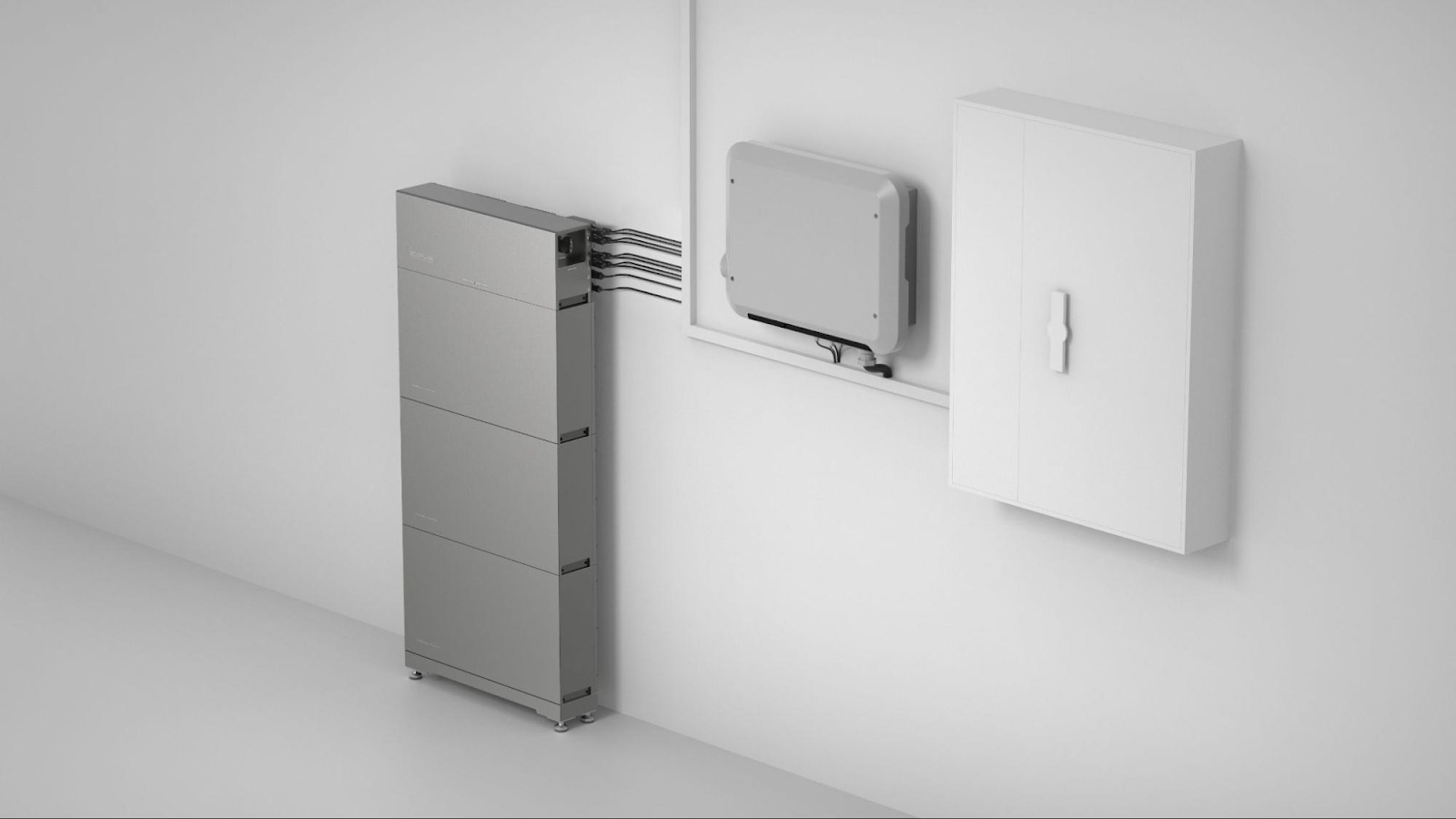
Choosing the right battery size for your solar rooftop system
Selecting the correct battery size for your rooftop solar system requires understanding your daily energy usage patterns and your solar array’s output. Here’s how you can approach sizing.
Matching battery capacity (kWh) to your daily patterns
Size your battery based on your daily surplus energy. If you use 10 kWh a day and want to store half of that, a 5-6 kWh battery works well. Smaller homes often get by with a 5 kWh battery, while bigger homes with EVs need around 10 kWh.
Your PV array capacity should also be sufficient to fully recharge the battery each day under ideal conditions. Consider usable capacity: EcoFlow’s 5 kWh LFP battery has a 95% depth of discharge, offering up to 4.8 kWh of usable capacity. It’s also modular, allowing additions as needed.
Considering hybrid and smart inverters
Hybrid inverters make solar and battery use smoother, storing excess energy rather than drawing from the grid. You can retrofit with an AC-coupled battery, which has its own converter, or use a DC-coupled solution that doesn’t require replacing the current converter. EcoFlow’s PowerOcean hybrid inverter simplifies installation by integrating solar panels, battery, and grid connection into a single system, eliminating the need for separate components.
Using batteries to improve your return on solar panels
Batteries accelerate savings from your solar panels, and understanding how they do that can increase your ROI.
Reduced grid imports
In the UK, grid electricity prices are high, so relying on it can jack up your utility bills. With a battery, you can cut annual grid imports by 50% to 80%. Recent analyses indicate that families using solar batteries save between half and three-quarters of their annual electricity costs.
Interaction with the Smart Export Guarantee
In the UK, the Smart Export Guarantee pays homeowners for each kWh of solar exported—but how much you get varies. Maximizing self-consumption gains the highest returns, with the SEG ensuring no export rate exceeds your electricity cost. The process encourages storing more solar energy, using it when the sun shines, and timing exports to maximize value from your solar roof.
Load shifting, ToU tariffs and demand-side management
Load shifting involves adjusting consumption to take advantage of cheaper rates. Many European countries now have Time-of-Use (ToU) tariffs, with electricity prices varying throughout the day. Here’s what you should know.
Time-of-use pricing
ToU structures charge different rates by time of day, incentivizing energy use during off-peak hours. Electricity prices are lower during periods of high solar generation and higher during peak-demand periods.
When combined with intelligent energy management, such as EcoFlow’s PowerInsight 2 monitoring, households can maximize solar self-consumption. PowerOcean can help you schedule battery operations to align with ToU tariffs, monitor real-time consumption and generation, and reduce operational costs.
Battery management and charge strategies
A well-designed, highly automated battery management system optimizes power based on your habits. The EcoFlow app provides real-time control, weather integration, and self-consumption prioritization.
Each battery module has a BMS that monitors and protects it. If one module encounters an issue, it won’t affect the whole system. The BMS prevents overcharging and overheating, enhancing safety and efficiency.
Backup, resilience, and islanding
Solar panels alone won’t keep your household powered during a blackout, but a good battery system will. Let’s explore how.
Household continuity during outages
When the power grid fails, a battery works like a small generator, powering essential systems. It disconnects your home from the grid and uses the battery and inverter to supply electricity—this is called “islanding.”
In island mode, your home becomes self-sustaining, and you can achieve this with the EcoFlow Backup Gateway (ATS), which provides up to 6 kW of backup power (single-phase) to keep essential circuits running.
The value of resilience
Having backup power really matters. For folks in rural areas with frequent outages, a battery is a lifesaver—preventing food from spoiling, helping with remote work, and keeping everyone safe when it counts.
Resilience fosters energy independence by enabling communities to generate their own power and support one another during crises. Beyond statistics, it brings peace of mind. A battery is more than a savings tool; it’s a vital backup system.
Schedule Your Free Consultation Today!
What kind of product or solution are you interested in?

How your solar roof and home storage work as one
A solar roof is more powerful with a home battery. While your solar array provides cheap, clean energy, a battery ensures that none of it goes to waste.
Upgrade your solar setup with the EcoFlow PowerOcean and start storing your own power, cutting bills, and gaining energy independence. Start with one home battery and expand as your needs grow.
FAQ
What size home battery do I need for my solar panels?
It depends on your usage and system size. Small homes often start with a 5 kW battery, which is enough for evening loads. Larger households ight opt for 10 kW or more. Modular systems like the PowerOcean allow you to start small and scale up later.
How much does a home battery increase self-consumption?
While solar panels increase self-consumption by 20% to 40%, a correctly sized battery can increase self-consumption between 60% and 80%. You can use at least two-thirds of your stored energy and significantly reduce what you send back to the grid.
How does adding a home battery system help me use more of my solar energy?
A home battery system helps you use more solar energy by storing it when you don’t need it. The PowerOcean saves your midday excess and supplies it after sunset instead of sending it back to the public grid, ensuring you use more of what you produce.
Can a home battery keep my power on during a blackout?
Yes, if you configure your home battery for backup, it can keep your power on during a blackout. A battery with an inverter that supports islanding can power essential circuits, providing short-term power until the grid is restored.
Is a solar battery storage system worth it in the UK?
Yes, a solar battery storage system is worth it in the UK, as it helps you avoid purchasing expensive peak-hour electricity by using stored solar and off-peak power. Most UK homeowners with batteries save hundreds of pounds annually.

