
What is an NCM Battery? A Deep Dive into Popular Battery Technology
Uncertainty during power outages is a major pain point for homeowners, but understanding the ncm battery, a high-energy-density technology using Nickel, Cobalt, and Manganese, is the first step toward true energy independence. While traditional batteries often struggle with heavy loads and short lifespans, the EcoFlow Ocean Pro with LFP battery provides the perfect long-term solution. By integrating advanced battery management with a massive 24kW output, it ensures your entire home stays powered reliably regardless of the grid's status.
What is NCM battery?
An ncm battery is a type of "ternary" lithium-ion battery defined by its complex cathode structure. The term "ternary" refers to the three transition metals used in the cathode: Nickel, Cobalt, and Manganese.
Each element plays a critical role in the battery's performance:
Nickel: Provides the foundation for high energy density, allowing the battery to store more power in a smaller footprint.
Cobalt: Acts as a stabilizer for the cathode structure, preventing degradation and ensuring a longer cycle life.
Manganese: Enhances thermal stability and structural integrity, while also helping to keep production costs competitive.
In the industry, you will often see these referred interchangeably as NCM batteries, NMC, or simply ternary lithium batteries. Regardless of the acronym, they represent the high-performance standard for energy-intensive applications where weight and capacity are the primary concerns.
The performance profile of NCM batteries
NCM technology is celebrated for its exceptional efficiency and versatility, making it the preferred choice for high-demand applications. Below is a detailed look at the core characteristics that define its performance.
Energy density: NCM is the gold standard because its high nickel content allows for superior energy storage per kilogram. This enables manufacturers to pack significant power into compact, lightweight designs without compromising capacity.
Voltage output: These batteries offer a higher nominal voltage, typically between 3.6V and 3.7V. This increased electrical potential allows systems to operate more efficiently, delivering consistent power for energy-intensive electronic components and motors.
Low-temperature resilience:NCM chemistry maintains impressive discharge efficiency even in freezing climates. Unlike other lithium types that struggle in the cold, NCM stays active, ensuring reliable performance and power delivery during harsh winter conditions.
Charging speeds: The intrinsic chemical mobility of NCM allows for rapid ion movement during the charging process. This results in significantly faster charging cycles, allowing users to replenish large capacities in record time.
Best practices for maximum NCM battery efficiency
To maximize the lifespan and efficiency of NCM-based systems, users should follow these core operational guidelines:
Use specified charging equipment: Always use chargers with stable voltage regulation tailored to the specific nominal voltage of your NCM pack to avoid over-voltage stress during the final saturation phase of charging.
Optimize the State-of-Charge (SoC) window: Avoid frequent deep discharges. Keeping the battery charge between 20% and 80% reduces mechanical stress on the cathode, significantly extending cycle life.
Long-term Storage Protocol: If the battery will not be in use for the upcoming months, store it at approximately 50% charge in a cool, dry place. Storing at 0% leads to deep sleep damage, while storing at 100% promotes high-voltage oxidation.
LFP Battery vs. NCM: the definitive comparison
Choosing between LFP battery vs NCM requires understanding the fundamental trade-offs between longevity, safety, and physical weight.
Cycle life: There is a significant gap in longevity between the two. While standard NCM batteries typically provide 1,000–2,000 full charge cycles before noticeable degradation, LFP batteries are endurance leaders, often reaching 3,000 to over 6,000 cycles, making them ideal for daily-use systems.
Thermal stability and safety: LFP chemistry is widely considered unconditionally safe due to its high thermal runaway threshold and stable chemical bonds. In contrast, NCM has a lower flashpoint and requires sophisticated Battery Management Systems (BMS) to monitor temperature and prevent overheating.
Cost and resource availability: NCM production is often more expensive and controversial due to the use of Cobalt, which faces ethical mining concerns and price volatility. LFP utilizes Iron and Phosphate, which are abundant, ethically sourced, and significantly more cost-effective for large-scale production.
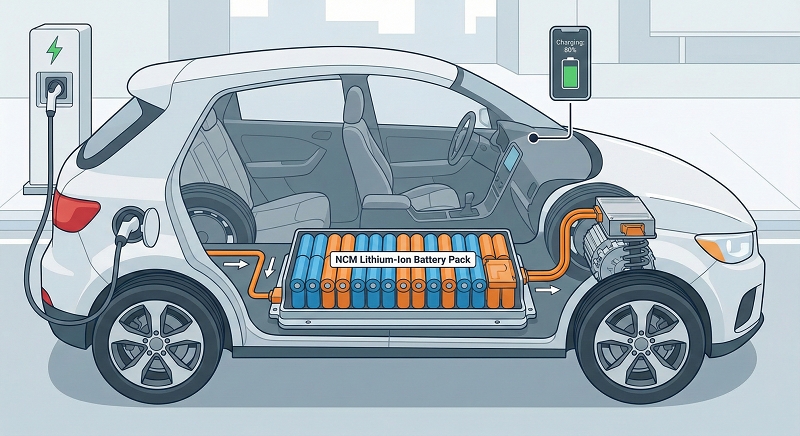
Weight vs. durability: NCM holds a clear advantage in portability; its high energy density makes it perfect for electric vehicles (EVs) where every pound matters for range. However, LFP is the preferred choice for stationary storage, such as home backups, where physical weight is less critical than long-term durability and safety.
Choosing your battery: NCM vs. LFP battery for specific needs
Selecting the right chemistry depends entirely on the application's environment and performance requirements.
When to choose NCM?
This chemistry is the ideal choice for high-performance electric vehicles, professional power tools, and mobile electronics. In these scenarios, the ability to store vast amounts of energy in a lightweight package is critical for range and maneuverability.
When to choose LFP?
LFP is the superior option for home backup and solar energy storage. In stationary applications, physical weight is secondary to long-term ROI, which is driven by LFP’s massive cycle life and inherent fire safety.
For homeowners seeking the ultimate balance of these traits, the transition to high-capacity stationary storage is best exemplified by the EcoFlow Ocean Pro. By utilizing advanced LFP battery technology, the Ocean Pro prioritizes the safety and 15-year longevity required for residential security while delivering exceptional high-surge power output—such as 205A LRA capability—that excels at starting heavy-duty appliances.
LFP battery for home needs: the EcoFlow Ocean Pro

EcoFlow Ocean Pro's
Technical specifications
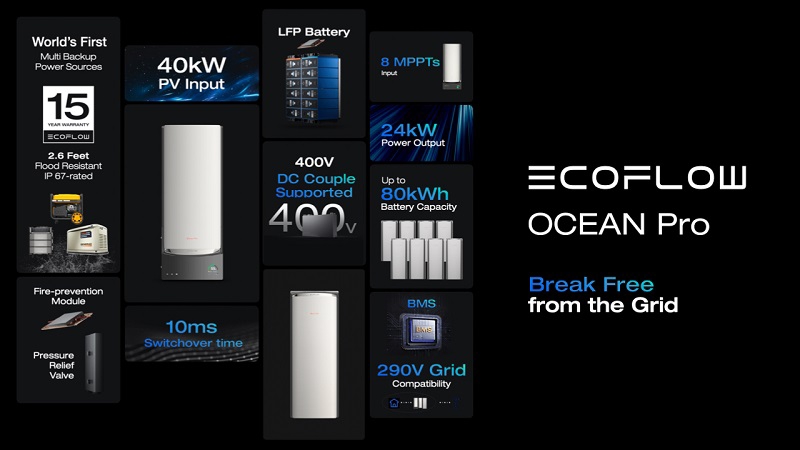
Power output: Delivers a massive 24kW continuous output with a 205A LRA (Locked Rotor Amps) surge capability, powerful enough to start two 5-ton air conditioning units simultaneously.
Energy storage: Features modular 10kWh units that are easily expandable up to 80kWh total capacity per inverter, tailoring storage to any home size.
Solar integration: Offers an industry-leading 40kW solar input supported by 8 independent MPPT trackers (5kW per channel), maximizing energy harvest even in complex roof configurations.
Environmental & safety: Boasts a NEMA 3R enclosure and IP67-rated waterproofing for battery modules (submersible up to 3.3 ft). It operates flawlessly from -4°F to 140°F and holds the world-first UL 9540B fire safety certification.
Advanced safety & management
The role of BMS: The integrated battery management system provides real-time diagnostics and active cell balancing. By constantly monitoring voltage and temperature, it effectively eliminates the thermal runaway risks that typically require more intensive management in NCM-based systems.
Active fire suppression: For ultimate peace of mind, the Ocean Pro incorporates specialized aerosol fire protection modules within the battery packs. This active suppression system adds a physical layer of defense, ensuring that the unit is not only chemically stable but mechanically protected against emergencies.
Key advantages of EcoFlow Ocean Pro over NCM batteries
The EcoFlow Ocean Pro provides several critical benefits that allow it to outperform standard NCM-based systems in a residential setting.
Unrivaled power capacity: This home power system manages a 100% whole-home load, including heavy industrial machinery and multiple central HVAC units. Standard 11kW NCM systems simply cannot match this output, leaving larger households vulnerable during outages.
Extreme weather hardening: Beyond waterproofing, the robust system and aerogel insulation protect LFP cells from thermal stress. This engineering provides environmental resilience that rivals the high-density performance of premium NCM battery designs.
Data-backed analysis: The EcoFlow mobile app-specific "Intelligent Mode" forecasts weather and utility rates to optimize discharge. By utilizing peak shaving, this data-driven approach saves users significant money, providing an economic advantage standard batteries lack.
Future-proof longevity: Backed by an industry-leading 15-year manufacturer warranty, the Ocean Pro’s LFP cells are built for extreme resilience. This longevity far outlasts the 10-year standard typically found in high-performance NCM alternatives.
Signing off
In the evolving landscape of energy storage, the verdict is clear: choose NCM for high energy density and mobility, but prioritize LFP for long-term home safety and longevity.
The EcoFlow Ocean Pro stands as the pinnacle of this technological evolution, solving traditional chemical trade-offs through superior engineering and intelligent software. By delivering massive power output within an ultra-safe LFP framework, it offers a future-proof solution for the modern home.
Thus, if you are ready to secure your energy independence, then explore the EcoFlow Ocean Pro today and transform your home into a resilient, self-sustaining powerhouse. Request a consultation with our professional experts right away!
What kind of product or solution are you interested in?

FAQ
1. What are the primary differences in an NCM vs LFP battery setup?
NCM prioritizes energy density and lightweight portability, whereas LFP excels in safety and longevity. While NCM is often found in EVs, the EcoFlow Ocean Pro utilizes high-grade LFP to ensure a 15-year residential lifespan and maximum home security without compromising on power output.
2. Are NMC batteries outdated?
No, NMC remains the industry standard for high-performance applications needing compact power. However, stationary storage is shifting toward LFP for safety. The EcoFlow Ocean Pro bridges this gap, offering LFP’s durability with the high 24kW discharge speeds typically reserved for premium NCM setups.
3. Are NCM batteries safe for indoor use?
Yes, NCM batteries are safe indoors when equipped with advanced monitoring. However, LFP is inherently more stable against thermal runaway. The EcoFlow Ocean Pro enhances this by using LFP chemistry and active aerosol fire suppression, providing the highest safety certifications for indoor residential installation.
4. Is NCM the same as lithium-ion?
NCM is a specific sub-category of lithium-ion technology, defined by its Nickel, Cobalt, and Manganese cathode. While many devices use various lithium-ion types, the EcoFlow Ocean Pro focuses on the LFP sub-category, providing superior thermal stability compared to standard NCM lithium-ion alternatives.
5. How does a battery NCM's voltage profile benefit high-surge appliances?
NCM’s higher nominal voltage supports efficient power delivery during intense bursts. While LFP typically has a flatter voltage curve, the EcoFlow Ocean Pro’s advanced engineering and robust design deliver a powerful 205A LRA surge capability, enabling it to easily start heavy-duty HVAC units and other high-demand loads with reliable performance.
