
Master Your Power: Simple Guide to Amp Hours to Watt Hours Conversion
Tired of struggling with an amp hours to watt hours conversion while sizing your backup power? It's a common frustration that often leads to runtime errors, leaving your home vulnerable during critical outages. Fortunately, the EcoFlow Ocean Pro + Intelligent Mode (via app) eliminates this guesswork by translating complex metrics into clear, automated energy insights. It is the perfect solution for hands-off efficiency.
What are AMP Hours and Watt Hours?
To master your energy, you must understand two key metrics:
Amp Hours (Ah): This measures electric charge. Think of it as the volume of water in a tank; it tells you how much "fluid" is available, but not how much force it has.
Watt Hours (Wh): This measures total energy. Using the same analogy, this is the actual work the water can perform when released under pressure.
It should be known that voltage acts as the bridge between charge and energy. Without it, Amp Hours are an incomplete data point.
Additionally, keep in mind that comparing batteries by Amp Hours alone is a common mistake. For example, a 100Ah battery at 12V only provides 1,200Wh of energy. However, a 100Ah battery at 48V provides 4,800Wh, four times the power capacity. Therefore, always look at the Watt Hours to understand the true potential of your backup system.
How to convert Amp Hours to Watt Hours?
If you need to calculate your battery's energy capacity manually, the amp hours to watt hours converter process is straightforward once you have the right formula. To find your total energy capacity, use the following simple equation:
Watt Hours (Wh) = Amp Hours (Ah) x Voltage (V)
To perform the aforementioned step, be sure to follow the step-by-step guide:
Step 1: Identify the battery voltage
Locate the nominal voltage on the battery label (common values are 12V, 24V, or 48V).
Step 2: Identify the Ah rating
Find the Amp Hour capacity (e.g., 100Ah).
Step 3: Perform multiplication
Multiply the two numbers to get the total Watt Hours.
Practical examples:
Scenario A (Standard Car Battery): A typical 12V lead-acid battery rated at 100Ah.
Calculation: 100Ah x 12V = 1,200Wh.
Scenario B (USB Power Bank): A high-capacity power bank is often marketed as "20,000mAh" (which is 20Ah, as 1 Ah equals 1000 mAh). These typically operate at an internal voltage of 3.7V.
Calculation: 20Ah x 3.7V = 74Wh.
Use case:
Converting to Watt Hours is essential when choosing an inverter. If you know your battery provides 1,200Wh and you want to run a 600W appliance, you can easily estimate that you have roughly 2 hours of runtime (ignoring efficiency losses). Without the conversion to Watt Hours, matching your battery to your household loads is nearly impossible
How to Convert Watt Hours to Amp Hours?
Sometimes you'll find yourself with the total energy number (Wh) but need to figure out the specific capacity (Ah). This usually happens when you are comparing expansion batteries or checking if a device is safe for travel. To flip the calculation, use the following watt hours to amp hours calculator equation:
AmpHours (Ah) = WattHours (Wh) ÷ Voltage (V)
One of the most common reasons for this calculation is travel safety. FAA and TSA regulations generally limit lithium batteries to 100Wh for carry-on luggage. If you have a battery labeled with "20Ah," you need to know the voltage to see if it's legal. For example, a 20Ah battery at 3.7V is only 74Wh (safe to fly), but a 20Ah battery at 12V is 240Wh (not allowed).
A simple step-by-step guide to perform the conversion:
Step 1: Take the total energy capacity
Identify the total Watt Hours (Wh).
Step 2: Identify the system voltage
Determine the voltage (V) of the battery or system.
Step 3: Perform the division
Divide the Wh by the Voltage to find your Amp Hours.
Practical examples:
Imagine you have a 2,000Wh solar generator and you want to expand its capacity. If you're looking at a 12V expansion battery, you need to know how many Amp Hours that equates to.
Calculation: 2,000Wh ÷ 12V = 166.6Ah.
This tells you that a 12V, 170Ah battery would roughly double your current storage.
Comparison table:
The following table shows how a fixed amount of energy (2,400Wh) translates into different Amp Hour ratings depending on the system voltage:
Total Energy (Wh) | System Voltage (V) | Resulting Capacity (Ah) |
|---|---|---|
2,400 Wh | 12 V | 200 Ah |
2,400 Wh | 24 V | 100 Ah |
2,400 Wh | 48 V | 50 Ah |
As you can see, higher voltage systems require fewer Amp Hours to achieve the same energy storage, which is why modern high-performance systems like the EcoFlow Ocean Pro often operate at higher voltages for better efficiency.
From manual calculation to AI automation: the EcoFlow Ocean Pro

EcoFlow Ocean Pro
Technical specifications & capabilities:
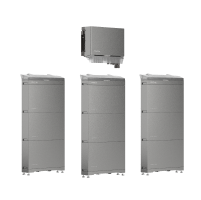
The Ocean Pro isn't just another battery; it's a sophisticated energy hub designed for high-performance home backup.
Massive &scalable capacity: It starts with a nominal battery energy of 10 kWh DC per unit. If your needs grow, the system is fully scalable up to 80 kWh by linking 8 battery units per inverter. It operates within a highly efficient voltage range of 380–550V DC.
Unrivaled power output: With a nominal output power of 11.5 kW or 24 kW (scalable up to 2 inverters), it easily handles 120/240V split-phase loads. Most impressively, it features a 205A LRA load start capability, which means it can effortlessly kickstart heavy-duty appliances like central AC units and well pumps that would stall lesser systems.
Rapid charging: You won't be waiting around for power. The maximum continuous charge power is 100A AC (24kW). On the solar front, it supports a massive 40 kW max input across 8 MPPTs, ensuring you harvest every drop of sun available.
Built for the elements: This system is as tough as it is smart. With an IP67 rating, EcoFlow OCEAN Pro can withstand up to 3.3 feet of water, ensuring continued operation during floods or extreme weather. It operates in extreme temperatures ranging from –20°C to 60°C and is backed by a 15-year warranty and UL 9540 fire safety certifications.
Mobile application support: TheEcoFlow mobile app's "Intelligent Mode" maximizes savings through Time-of-Use (ToU) arbitrage, solar optimization, and peak shaving. It further protects your finances by predicting severe weather via storm guard and identifying inefficient vampire loads through smart circuit management, ensuring your home energy system remains both autonomous and highly cost-effective.
Suggestions for choosing the correct battery for your needs
Selecting the ideal battery involves more than just picking the largest capacity. You must align your storage with your daily consumption and long-term goals to ensure a reliable, cost-effective energy solution for your home or mobile setup.
Calculate daily consumption: Start by identifying your essential daily loads. If you only need to power lights and a fridge, a smaller 5kWh unit might suffice. However, for whole-home coverage including heavy appliances, aim for at least 10kWh capacity.
Evaluate voltage compatibility: Ensure your battery voltage matches your charging system. While 12V is excellent for small DIY setups or RVs, 48V or higher systems, offer significantly better efficiency and less energy loss for permanent installations.
Prioritize chemistry and life cycles: Look for Lithium Iron Phosphate (LFP) batteries. These offer much longer life cycles compared to lead-acid or standard lithium-ion options. A high-quality LFP battery can last over a decade, providing superior long-term value for your energy investment.
Plan for future scalability: Home energy needs often grow over time. Choosing a modular system allows you to start small and add battery units as your budget or power demands increase, preventing the need for a complete and expensive system overhaul later.
Signing off
Mastering the relationship between Amps, Volts, and Watts is the key to true energy independence. By understanding how to convert between these units, you're no longer guessing; you're building systems with precision and confidence.
However, as energy technology evolves, the burden of manual calculation is fading. The EcoFlow Ocean Pro represents this future, using its integrated intelligence to handle complex conversions and cost-saving optimizations automatically. So, if you are ready to integrate efficient energy usage in your home, then be sure to request a consultation with our professionals today!
What kind of product or solution are you interested in?
FAQ
1. Does converting AMP Hours to Watt Hours account for efficiency loss?
Theoretical conversions provide a maximum capacity, but ignore heat and inverter losses, which typically reduce efficiency by 10–15%. While manual calculations offer a baseline, the EcoFlow Ocean Pro's Intelligent Mode tracks real-time data to account for these electrical inefficiencies automatically
2. How many watt hours are in an amp hour?
One amp hour's energy depends on the system's voltage; at 12V, it equals 12 watt hours. The EcoFlow Ocean Pro uses a 380–550V architecture to store 10kWh per unit, reducing energy loss and enabling higher efficiency than standard low-voltage batteries.
3. Will a standard AMP Hours to Watt Hours calculator work for both 12V and 48V systems?
Yes, the mathematical relationship remains the same across all voltages. However, while manual calculators rely on user accuracy, the EcoFlow Ocean Pro manages high-voltage transitions internally, providing precise energy data and removing the risk of errors associated with voltage-matching
4. Why use amp hours instead of watt hours?
Amp hours measure electrical charge capacity, but watt hours measure the actual work a battery can perform. Watt hours are more useful for home backup systems because they provide a universal capacity rating that remains consistent regardless of the voltage.
5. Does Watt Hours to AMP Hours conversion give me the exact runtime for my appliances?
No, because actual runtime depends on ambient temperature and fluctuating appliance loads. While static conversions offer a starting point, the EcoFlow Ocean Pro's intelligent mode analyzes specific household usage patterns to provide a more reliable and dynamic runtime forecast.
